Peer Review Policy
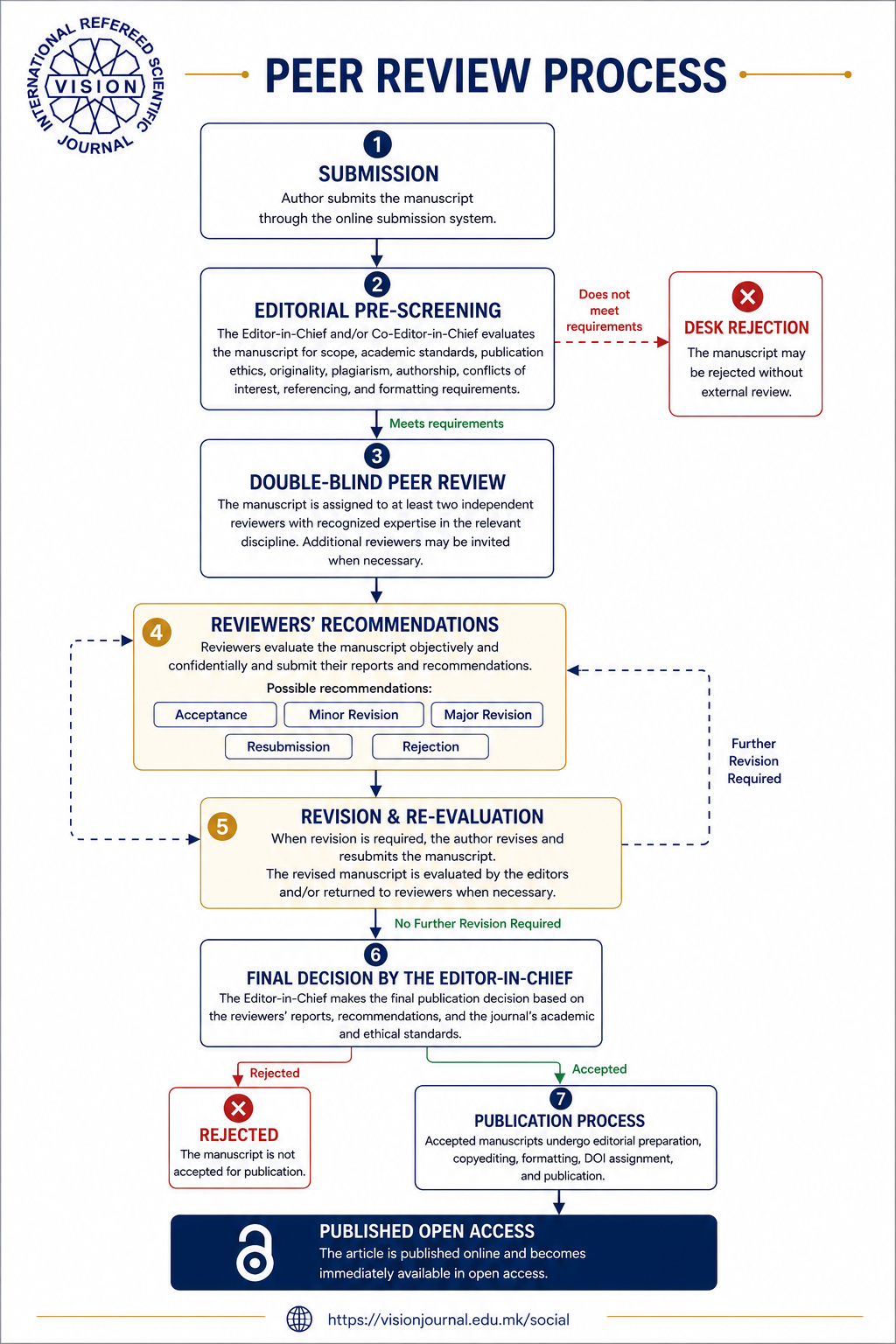
The International Scientific Journal Vision is committed to maintaining the highest standards of academic quality, research integrity, editorial independence, and transparency. All manuscripts that successfully pass the editorial pre-screening are subject to a double-blind peer review process and are evaluated by at least two independent reviewers with relevant subject expertise. The peer review process is designed to assess the originality, scientific soundness, methodological rigor, scholarly contribution, and relevance of each manuscript to the journal's aims and scope.
Under the double-blind review system, the identities of authors are not disclosed to reviewers, and the identities of reviewers are not disclosed to authors throughout the review process. Editorial decisions are based exclusively on the academic quality and scientific merit of the submitted work.
Editorial Pre-Screening
Every submitted manuscript first undergoes an initial editorial assessment conducted by the Editor-in-Chief and/or the Co-Editor-in-Chief. During this stage, manuscripts are evaluated to determine whether they:
-
fall within the journal's aims and scope;
-
comply with the journal's submission requirements;
-
meet basic academic, ethical, and scientific standards;
-
demonstrate originality and scholarly contribution; and
-
contain the required declarations, including conflicts of interest and ethical approvals where applicable.
Manuscripts that do not satisfy these requirements or clearly fall outside the journal's scope may be rejected without external peer review.
Similarity Screening
Before peer review, manuscripts may be screened using plagiarism detection software such as iThenticate or Turnitin or similar programmes. Manuscripts containing plagiarism, duplicate publication, fabricated or falsified data, inappropriate image manipulation, or other forms of research misconduct may be rejected in accordance with the journal's Publication Ethics Policy.
The journal reserves the right to reject a manuscript at any stage of the editorial process if serious ethical concerns are identified.
Peer Review Process
Manuscripts that successfully pass the editorial assessment are assigned to at least two independent reviewers with expertise in the relevant subject area.
Reviewers are selected solely by the editorial team based on their academic qualifications, research experience, and subject expertise. Although authors may suggest potential reviewers where permitted by the submission system, the final selection of reviewers remains entirely at the discretion of the editors.
Where necessary, additional reviewers may be invited to ensure a fair, objective, and comprehensive evaluation.
Reviewers are expected to evaluate manuscripts objectively, impartially, confidentially, and within a reasonable period of time. Their assessment should focus on the originality, scientific contribution, methodological quality, clarity, relevance, and overall academic value of the manuscript.
Reviewer reports are treated as confidential documents and are used exclusively for editorial decision-making.
Confidentiality and Conflict of Interest
Editors and reviewers are required to maintain the confidentiality of all submitted manuscripts and must not disclose, distribute, or use unpublished information for personal, academic, professional, or financial benefit.
Editors take all reasonable measures to prevent conflicts of interest between authors, reviewers, and members of the editorial team.
Reviewers and editors must declare and avoid any actual or potential conflict of interest that could compromise, or reasonably appear to compromise, the impartiality of the evaluation process. Editors with a conflict of interest regarding a manuscript shall not participate in reviewer selection, editorial evaluation, or the final publication decision.
Editorial Decision
Based on the reviewers' reports, the Editor-in-Chief may decide to:
-
Accept;
-
Request Minor Revisions;
-
Request Major Revisions;
-
Invite Resubmission following substantial revision; or
-
Reject the manuscript.
Reviewer recommendations serve as expert advice to the editorial office. The final publication decision rests exclusively with the Editor-in-Chief after considering the reviewers' evaluations, the scientific quality of the manuscript, its originality, and its compliance with the journal's editorial policies.
Where reviewer recommendations differ substantially, the Editor-in-Chief may appoint an additional independent reviewer or make a reasoned editorial decision based on the available evaluations.
Revised Manuscripts
Authors requested to revise their manuscripts should submit both the revised version of the manuscript and a point-by-point response explaining how each reviewer's comment has been addressed.
Where considered necessary, revised manuscripts may be returned to the original reviewers for further evaluation.
Editorial Independence
Submissions authored by editors, members of the Editorial Board, or individuals closely associated with the journal are subject to exactly the same double-blind peer review process as all other submissions.
Such manuscripts are handled by an independent editor who has no conflict of interest with the author. Editors who are authors of a manuscript are excluded from every stage of the editorial handling and decision-making process relating to their own submission.
Peer Review of Special Issues
Articles submitted to special issues are subject to the same editorial standards and double-blind peer review process as articles submitted to regular issues. Each manuscript is evaluated by at least two independent reviewers.
The Editor-in-Chief retains overall responsibility for the academic and ethical integrity of all special issues. Guest Editors operate under the supervision of the Editor-in-Chief and/or designated members of the Editorial Board and do not have unilateral authority over final publication decisions.
Manuscripts authored by Guest Editors are handled independently by an editor who has no conflict of interest with the authors. Guest Editors do not participate in the selection of reviewers or editorial decisions concerning their own manuscripts. Articles authored by Guest Editors shall not exceed 25% of the total research articles published in the special issue.
Reviewer Guidelines
Reviewers are expected to provide constructive, objective, and evidence-based evaluations that contribute to improving the quality of submitted manuscripts. Reviews should be respectful, professional, and free from personal criticism. Reviewers should notify the editorial office promptly if they are unable to complete a review within the requested timeframe or if they identify any ethical concerns during the evaluation process.
Commitment to Best Editorial Practice
The International Scientific Journal Vision is committed to maintaining a fair, objective, independent, transparent, and timely peer review system. The journal encourages editors, reviewers, and authors to follow internationally recognized principles of publication ethics and best editorial practices, including the recommendations of the Committee on Publication Ethics (COPE), in order to safeguard the integrity of the scholarly record and promote excellence in academic publishing.